Showing posts with label nuclear. Show all posts

Monday, 6 March 2017

What's stopping Small Modular Reactors

Small modular reactors (SMRs) are a class of nuclear fission reactors that aim to address some of the shortcomings of existing large scale nuclear power plants. These shortcomings include the capital cost of the plant, the lead time for construction of the plant, the ability to process existing nuclear waste into fuel, requirements for the location of the power plant and the complexity of safety systems required. There are a number of different SMR designs that have been put forward over the last two or three decades that using various fuel sources, reaction physics and construction techniques. One thing they all share in common is that they have promised much and delivered little: few of them are even close to having production power plants in service.

This raises a big question in my mind: why have they failed to materialise? The benefits that the claim over the established large scale GenIII reactor and power plant designs would seem to be potential game changes in the nuclear energy industry. You'd expect a few companies at least to have made progress into a production system over the last three decades for a technology that promises so much with existing engineering and physics knowledge, but they haven't.  Why?

One reason is regulations. SMRs, like all nuclear power plants, require a huge effort to pass regulatory hurdles in most countries.  For good reasons, these regulations are very detailed, and thus expensive, to comply with. You don't want people building more dodgy reactor designs that have proved problematic in the past after all.

Thus only companies that have deep pockets can really successfully play in this field, unless governments step in to provide support. The regulations are also angled towards the large existing nuclear reactor designs we've had in the past, and its up to the SMR proponents to prove to the regulators that (if?) their reactor designs are inherently safer. The regulators need to be shown that failure modes have been removed without other new ones being introduced.  That costs money.

Unfortunately, a number of the newer GenIV SMR designs aren't being proposed by existing nuclear companies or by billionaire backed corporations. Instead, their initial designs have been proposed and developed on relatively low shoe string budgets.  To get through the regulatory barrier these potentially disruptive start ups need to attract a large amount of speculative investment, or have their ideas taken up/bought out by "one of the big boys".

The existing nuclear power companies don't really want anything disrupting their current game plans, and anyway many of them have big problems of their own financing their operations (see for example the pains of Westinghouse/Toshiba and EDF/Areva recently).  There are a few companies backed up with investment cash, and they're probably the best hope for the SMR market to develop at the moment. If even one of those gets into production and starts to turn a profit, investment capital may magically appear for some of their potential competitors.

Once past regulatory approval in one country, many of the SMR designs then rely on the promise of a production line assembly of power station modules in order to keep their overall costs down.  This is a great idea in principle - one of the reason that existing GenIII nuclear power plants cost so much is that each one is effectively a bespoke, one off project, even if they share a common basic reactor design. The production line would have to have a steady flow of orders coming in - the worst thing for a manufacturing industry is a bursty demand for its products, as it runs the risk of going bust in the lean times. 

To keep this production line going, the SMR company would need either a large market in the first country to approve its reactor design, or would need the approval in one country to smooth the path through nuclear regulations elsewhere (with "smooth" meaning "radically reduce the time and costs"). Thus getting a design approved for use in the UK, whilst a big hurdle to jump, only gives you ready access to a relatively small market.  Really these companies need to get approval in somewhere large like the USA, China or Russia to provide the steady flow of orders and income to keep them going whilst gain access to markets elsewhere.

And this really gets to the heart of the issue: so many things, with so much money involved, have to go right worldwide for SMRs to work out.  Its not a technology that can scale up from really small, cheap demonstrators and have relatively easy access to a wide range of markets worldwide. This is unlike solar PV technology for example: there you can build out power plants of different sizes, in different country all using the same factory produced PV panels and mounting hardware that can be shipped more or less anywhere.  It doesn't matter to the panel manufacturer if you're buying eight 250W panels to put on a terraced house roof in the UK, or several thousand to build a solar farm in a desert in the US as people are doing both, all over the world. You can scale the PV technology from cheaper, smaller setups with minimal governmental intervention right up to multi-megawatt power plants.  The same applies to the growing market for storage technologies - the same lithium cells are going into domestic battery packs and electric cars as are being put into utility scale grid storage systems and electric lorries and buses.

So what's the way out of this for the SMR proponents?  Will it be a technology that, like nuclear fusion, is always 20 years away?  Maybe the "small" in many SMR designs are still too big? There are some "very Small Modular Reactor" (vSMR) designs out there with less than 10MWe output.  Maybe one or more of those will crack the nut of regulation and production line manufacture for military or off-grid remote power setups that will then let the companies involved scale up to utility sized, grid connected power plants?

But really it seems to all come down to regulation and finance. Some countries appear to be moving in the direction of reassessing their regulatory framework and financing for new nuclear technologies, but it is a very slow movement and may be too slow for some of the companies pushing the more radical SMR designs. Time will tell, but it appears there may be more losers than winners in SMR, and this isn't going to be oft promised silver bullet to make new nuclear a big contributor to low carbon power transitions before 2030.

Friday, 28 August 2015

Wacky idea time: Nuclear powered ocean going freight islands?

Nuclear powered ocean going vessels have been around for decades.  As well as the well known nuclear power submarines with their deadly payloads of nuclear weapons that can stay submerged for months at a time, there are also nuclear powered aircraft carriers and icebreakers out there.  Nuclear power plants for shipping are expensive but have the advantage of large power outputs, less time spent refuelling and low carbon footprints.

The latter point on carbon footprints made me wonder: onshore nuclear power stations can offer low carbon electricity outputs, but are now massively expensive to build, get mired in politicial objections left, right and centre, and are often unpopular with the local residents around proposed sites.  We need to find a way to deal with long lived nuclear waste from the legacy nuclear power stations. At the same time we need to find low carbon ways to ship bulk goods around.  And it would be great if we could get cheap, renewable replacements for existing liquid fossil fuels so that we could keep more fossil fuels in the ground.  What if we could find a way round all of those issues?

So, my quick brain fart for today: build very large, ocean going freight vessels that are nuclear powered.

By "very large" I mean bigger than the largest oil tankers available today by an order of magnitude - effectively floating metal islands that can plough across the oceans from continent to continent.  Obviously they'd be too big for most ports to handle and many people may object to a nuclear powered vessel turning up in their local harbour (unless they're used to the military ones already).  However what about if these giant vessels went just to the edge of territorial waters and unloaded onto smaller vessels?  Those smaller vessel would be normal sized, conventionally power container ships and tankers.

If you build something big enough, you could effectively include a dock inside the huge ship for normal vessels to go into, protected from rough seas. The loading/unloading of the smaller ships could even be done enroute, which would mean that transshipment and handling time wouldn't be increased. Bringing boats inside a larger ship is already done: the US Navy have vessels that can take smaller boats inside for long distance transport, equipping and deployment.  Or if you're into sci-fi its like the James Bond baddie with the oil tanker that could swallow submarines. Paging Elon Musk on that one!

Manufacture of this mega-freighter would have to be modular so that existing ship yards could build them sections at a time.  Each completed section would be floated out of the dry dock and then joined up to other sections already held at sea.  That's the bit I'm really not sure about: how easy would it be to join up sections at sea that are floating? That would obvious require calm weather to do, but could the modules be designed to interlock easily like some sort of giant floating Lego bricks?  I don't know - I'm not a shipwright or naval architect.  However large floating structures have been joined together in the past, so I don't think its insurmountable.

These floating freight islands would have to be powered by nuclear reactors that provide propulsion power, "hotel" power to keep the crew (and maybe passengers) supplied with heat, light & electricity and potentially enough "extra" power to use the various Fischer-Tropsch processes to combine sea water with air to produce liquid hydrocarbon fuels.  We already know that works - the US military have tried it to produce jet fuel onboard their nuclear powered aircraft carriers.  The synthetic hydrocarbon fuels could then be used to fuel the smaller servicing freighters and/or provide av-gas for helicopters or VTOL aircraft for the short hops to and from shore.

By using the nuclear reactors for the long haul ocean part of the freight journey we'd be reducing the carbon footprint of the goods.  The reactors will effectively live out their lives at sea, many miles from the nearest land. If the reactors are designed using the proposed Gen-IV designs they'll be "walk away safe", and something so massive as this would also mean it would be unlikely to leak radioactive material into the sea (I assume the reactors would be in the heart of the floating metal island, so there could be a lot of steel and concrete between them and the water).  Indeed this might be a great application for the various designs of modular reactors - don't build a ship with one 1GW pressurised water reactor but instead 10 modular 100MW molten salt reactors that can be swapped in and out for refuelling and replacement.  That would help with the economies of scale that modular reactor designs really need if they are going to be constructed on a production line to bring costs down and safety up.

Tsunamis and earthquakes wouldn't be an issue for these reactors, and if they're making enough synthetic fuels as a by product of the reactor running they could even help provide low carbon fuels for import to the countries they visit.  Indeed if they moor up at a fixed off shore point, they could be hooked up to the Grid in that country by a relatively short undersea HVDC power cable.  It might transpire that some could even be nearly permanently moored like that as a safer place to put nuclear capacity for the Grid's low carbon base load supply.

I wonder what the limitations of build these would be?  Cost is an obvious one: a nuclear submarine costs a couple of billion US dollars to make, and this would be something far larger.  Yet Governments and companies are already handling projects that cost many tens of billions - things like new build on-shore nuclear power stations, failing Carbon Capture and Sequestration (CCS) projects, high speed rail lines, etc.

The anti-nuclear lobby would probably object to this as its another application of nuclear power, but if the Gen-IV design could make use of legacy high level nuclear wastes, it might be palatable as a way of cleaning up wastes from previous generations of nuclear reactors (which is after all one of the anti-nuclear groups' major concerns). Also there are already many nuclear reactors swimming around in the ocean and have been for decades.

I'm not sure what the legal position would be for nuclear reactors running on vessels in International waters that never actually enter territorial waters once launched. Would it be covered by the flag that the ship sails under? Could you pick a small country that doesn't have a huge amount of nuclear regulation red tape in order to make this viable?

Saturday, 2 May 2015

Energy storage and nuclear power

A couple of days ago, Elon Musk, the billionaire serial business creator, fronted a product launch at one of his companies - Tesla Motors.  Telsa is renowned for building high quality electric cars but this launch wasn't for a car: it was for batteries.  Elon was explaining how the battery technology originally developed for the Tesla cars will now be available to home owners and companies to provide electricity storage.  The news has naturally focused on the $3500 10kWh domestic battery pack, but I think the real killer is in the industrial, grid scale scalable storage that they are going to offer.  This is interesting enough for one un-named utility to already put their name down for 250MWh of capacity, and indeed its the industrial/utility side that analysts see as the major market.

Which got me thinking: how much solar/wind/etc generation and Tesla storage could you buy for, oooh, say the cost of EDF's proposed Hinkley Point C nuclear power station?  The estimated cost of Hinkley Point C keeps going up, but lets use the original EDF £16bn figure here.  Hinkley Point C is a 3.2GW station, so we need to try to match that using renewables for £16bn ($24.22bn at the current exchange rates).

Now first off I have to say that this is just me getting some ball park figures: its not an engineering analysis.  I just want to see if Tesla's batteries plus renewable generation can give us a stable base load power source to the National Grid that would look to the outside world as though a 3.2GW nuclear station were sitting there. To do this we'll need more than 3.2GW of renewable generation capacity: we not only have to match the nuclear station's peak output, but also fill the batteries so that we can also supply power at night and on calm, overcast days.  Lets assume that we want 3 days worth of energy in the batteries to cover these low generation periods to start with.

Now we don't know what cost Tesla's commercial utility scale power packs are going to be, but we do know that the residential 10kWh ones will cost $3500, or in other words $350 per kWh.  I would assume that an economy of scale kicks in when you're buying a huge amount of batteries for utilities that would reduce this $350 per kWh figure for the utility scale one.  Lets say it knocks $50 off the figure - yes, that's a wild, stab in the dark guess, but its seems vaguely sensible and conservative.  So we need three days worth of 3.2GW generation stored:

3 days x 24 hrs x 3.2GW = 230.4GWh = 230400000kWh

At my estimated $300 per kWh that will cost:

$300 per kWh x 230400000kWh = $69120000000 = $69.12bn.

Ah, that's blown the $24.22bn budget already, and we haven't even paid for any of the renewable generation yet - this is just the cost of 3 days of Hinkley Point C sized output storage.

Lets plough on though, and see what the final number is.  For large scale renewable power generation, the costs are falling (ie going the other way to nuclear!).  Large scale wind turbines cost $1.5m-$2m per MW of output.  Large scale solar farms cost ~ £1.6M ($2.42M) per MW if I've read the slightly confusing Solar Trade Association report right.  Lets pick $2M per MW as reasonable wet finger guesstimate of cost for both wind and solar then.

We need to generate more than 3.2GW though: we want to match Hinkley Point C's output when we're generating at our peak and have lots of excess generation capacity available then to fill up the Tesla batteries for the periods when its calm and dark.  Lets guess again and say that we need twice the generation capacity to do this.  We might need more, we might need less, but 6.4GW again seems like a reasonable first guess.

At our $2m per MW estimate of renewable generation costs, this 6.4GW will cost $12.8bn.  Well at least that bit is under the $22.42bn Hinkley Point C budget!

How much energy storage can we get for the $9.62bn difference?  At $300 per kWh estimate we get:

$9.62bn / $300 per kWh =~ 32GWh

So that's about 10 hours worth of storage if we're going to be sucking 3.2GW from the battery system. That's still not bad, but will it be enough to allow large scale solar and wind to challenge nuclear for base load power generation in a decarbonised Grid?  Some people think so, and the numbers will fall on the side of renewables+batteries if their cost trajectory keeps going down in the same direction whilst nuclear's costs keep rising.  It will be interesting to see how this plays out.


Friday, 22 November 2013

Post nuclear differences

In the wake of the Fukushima Daiichi nuclear power station disaster in early 2011 both Japan and Germany changed their stance on nuclear power generation. Some nuclear plants were shut down immediately and the rest will most likely be decommissioned with the next decade.  Both countries appeared to have widespread public support for this radical change in their national energy policy.
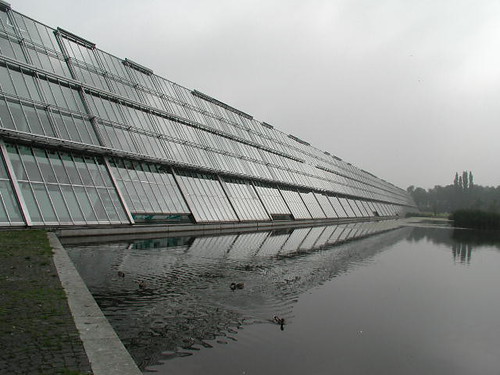
Solar city, science park, Gelsenkirchen.
Source: Green Baroque Ins. Flickr under Creative
Commons CC BY-NC 2.0 Licence 

The effect these decisions have had on these two nations response to climate change is interesting.  Germany was already well into building out its solar & wind based renewable generation capacity before the earthquake and tidal wave wrecked the reactors in Japan. With widespread community involvement in the investment in renewables, and helpful financial and regulatory environment provided by the German authorities,  they've been able carry this forward.  They've still got fossil fuels in their mix but they do still seem to be on target for their carbon emissions targets.  Germany already had a strong anti-nuclear movement and was planning on phasing out nuclear by 2036 anyway so this event really accelerated that timetable.

Japan on the other hand have just announced during the UN COP19 climate change talks that they were going to have to substantially reduce their existing emissions reduction target.  They are building renewable generating capacity of course - practically every developed nation is.  However it will not be enough to cope with losing all the nuclear generating capacity that they are removing,  which prior to March 2011 contributed around 30% of their total generating capacity.  They are having to turn to increasing use of imported fossil fuels as oil, coal and gas to supply their electricity.

I was wondering what we could learn from the different outcomes arising from what, at first, appear to be very similar decisions.  Germany had something of a head start as they were already aggressively building solar PV & wind generators. But they also have a geographic  advantage over Japan: Germany is bigger with more land available.  Solar & wind both have low "energy density" so to get a decent amount generated you need alot of them covering lots of roofs & land. Japan is a relatively crowded country so space is at a much higher premium.  As a comparison Japan is 39th in the population density league table whereas Germany is 58th.  Japan does have potential for many gigawatts of renewable power generation though, as it has amply space in the seas around it for large scale off-shore wind farms.  There does appear to be the need to encourage more community involvement and investment in on-shore renewables though.
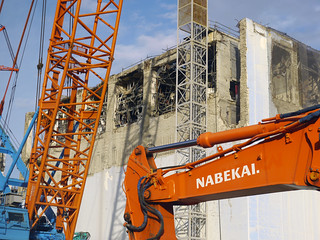
Fukushima Unit 4 with cranes working on 
stabilizing the site. Source: IAEA Imagebank under 
Creative Commons CC BY-NC-ND 2.0 Licence

Both nations have to bear the costs of decommissioning their nuclear infrastructure, which will mostly likely be a long and expensive task.  Again Germany has an advantage - it only had 17 nuclear power stations operating prior to March 2011 whereas Japan had over 50.  Germany was already well into decommissioning quite a few reactors, especially from the former East Germany.

Japan also has the expense and difficulty of cleaning up Fukushima itself to deal with. That's going to be a big drain on the resources of both its owner Tepco and the Japanese government. The clean up may well be competing for funds, people and time required to ramp up construction of  renewables, even though those renewables are part of the solution to the overall problem. Indeed one wonders if the exclusion zone around Fukushima might well end up being a good place to site renewables with their relatively low maintenance requirements (so fewer people have to spend less time in the potentially more radioactive areas).  At least they might provide some economic payback to the people whose land is otherwise now worthless.

Japan's economy has taken some serious blows over the last few years, which also puts them at a disadvantage against Germany. Germany is the economic power house of the EU, and so it can afford to invest in the capital cost of renewables. Indeed its a positive cycle for the Germans: the more renewables they can invest in the more insulated they are from fossil fuel price rises, which improves their competitiveness and increases their income, part of which they can invest in more renewables.  Japan has the opposite problem - its emergency switch to large scale fossil fuels to replace the nuclear power stations is costing the Japanese power companies an extra 3.6 trillion yen in 2013 over the costs in 2010 before the disaster.  Things are likely to get worse for Japan before they start to get better.

There is one overarching "take home message" I pick up from the different reaction to the change in energy policy in the two countries.  The sooner a nation starts to make a large scale switch to distributed renewable power generation, the better placed it is likely to be to deal with sudden, external changes in traditional centralized power generation.  In this case it was the rapid removal of all nuclear capacity but in the future who knows what it will be?  Gas pipelines cut off as part of national sabre rattling? Wars leading rapid price rises in global oil prices? Coal shipments being disrupted by industrial unrest?  All of these could affect national grids that rely too heavily on one particular fuel source, especially if that fuel is controlled by others.  We all need to be investing in clean, distributed energy generation to make our nations, towns, cities and communities more resilient in the face of these unexpected changes.