I was chewing the fat over nuclear reactor designs with a chum on Twitter when something struck me. One of the big issues in producing new nuclear designs is finding somewhere to build a prototype to validate the design. There's lots of interesting, and potentially much safer and cleaner fission reaction designs being mooted, but most of them stay as computer simulations or paper designs because its increasingly difficult to get regulatory approval for building the reactors.
This is understandable in a way: few countries want to make it easy for companies to build dodgy designs that could leak radioactivity into the environment. This means that reactor designs need to be carefully approved usually, which is very, very time consuming and thus very, very costly.
It also plays into the hands of the incumbent reactor manufacturers. Their designs are often evolutions of older, well understood reactors and the companies know the ropes of regulatory approval. The regulators also know the companies and people involved. These same companies also have a vested interested in not allowing some of the GenIV designs to be rapidly developed as they make quite a bit of their income from selling fuel rods for existing fission reactor designs, which some of the newer designs do away with (most notably pebble bed reactors and molten salt reactors using liquid fuels).
So onto my wacky idea: why not do initial validation of new reactor designs in space? There are some distinct advantages:
a) If the design fails, a leak isn't going to be an ecological disaster. If you put a reactor on the moon or an artificial satellite outside of Low Earth Orbit (LEO) reactor leaks aren't going to get back into Earth's biosphere terribly easily.
b) Space access charges are falling. Companies like Elon Musk's SpaceX are reducing the price of getting mass into orbit. At the moment most of this is targeted at getting equipment and people into LEO (for example supplying the ISS) but the basic launcher technology developments are ultimately aimed at getting mass to Mars. Having a commercial funding opportunity get part of the way there would help the commercial space launch industry as well as the nuclear industry.
c) Whilst getting the equipment into space is expensive, it might be offset against the cost of the massively constructed containment buildings that are often required on Earth but wouldn't be required for the validation reactors in space. Who cares if you've got minimal containment on the reactor if there's no biosphere to pollute?
d) Advanced robotics mean that you might well not need to send people up with these reactors, so you don't even have to worry about worker contamination/decontamination.
e) No extra nuclear waste will be generated on Earth, which is good seeing as Governments are still flapping about what to do with the stuff we've already generated. If anyone is worried, provide ability to fire into the Sun!
There are downsides of course (probably lots of them considering this is just recording one of my brain farts!):
a) Getting radioactive material into space is nearly as tricky from a regulatory point of view as building the reactors. Folk don't want radioisotopes being blown up all over the sky for some reason. Radiothermal generators have been sent out on space craft though so its not insurmountable, especially if space access charges mean that you can spread your fuel load into a number of small consignments spread out over many launches (so one launch failure doesn't mean a full reactor load of fuel being exposed to the biosphere). Fuel containment and escape options may also help, especially as we have experience of equipment that has survived rocket explosions in the past.
b) Lack of gravity may affect some reactor designs. This would require artificial gravity to be provided (simulated by rotating the reactor to give a 1g acceleration). Reactor designs that don't suffer from this may of course be of interest for space exploration applications themselves.
c) Validation of a reactor design in space will still then require national regulators to accept the results. This is unproven and may be just as costly/long winded as getting the prototypes approved for Earth bound deployment.
d) Hostile environment: whilst space doesn't have a biosphere to pollute, it does have micro-meterorites, difficult thermal gradients (very cold in shadow, boiling in the Sun), solar winds, etc, etc to deal with. Lots of engineering fun to be had!
Well, just an idea. Worth kicking out there for comment and thoughts though!
Sunday, 20 October 2013

Saturday, 14 September 2013
Allotment waiting lists & community gardens
In many parts of the country there are long waiting lists for allotment plots. In some large towns and cities these waiting lists might stretch for years. People often complain that councils should "do something" about them and often mention getting groups together to demand more space for allotments. Unfortunately few councils are in the position to make new land and what property holdings they do have are now under pressure to return a decent income, especially with all the deep cuts in their budgets recently.
At the same time we have community gardens struggling to keep going due to the need for volunteers. These shared growing spaces are often set up to provide garden beds for those with no access to their own backyards, but they can also give schools that lack their own gardens beds for the children to grow in. Community gardens should really be a place to help build community spirit & cohesion but it seems many of them struggle to recruit enough volunteers interested and/or knowledgeable in gardening to sustain their development.
So here's an idea for councils: take your allotment waiting list and point people on it to their local community garden. Folk who take up the challenge and help at the community garden get to move more rapidly up the waiting list. This has a number of benefits :
* councils are seen to be "doing something" about allotment waiting lists,
* community gardens are likely to get a steady flow of volunteer gardeners, some of whom might well stick around even after getting their own allotment plot,
* new comers to allotments & gardening get to sample what the work is like, the ups and downs of growing & pick up hints and tips before they take up their own plot. Some folk like the idea of gardening more than they like the actual work, and so this might "weed them out" before a precious allotment plot is allocated to them,
* links will be forged between the community gardens & allotment sites, which may help with things like Tool Banks, harvest festivals, In Bloom schemes, etc.
Now some people might not want to do shared gardening and just want their own private plot. That's fine - they can just stay on the council's allotment waiting list. They might be leap frogged by some more sociable, community minded folk, but they might also find some folk drop out of the list when they discover the time & effort commitment gardening imposes.
Sunday, 7 April 2013
Indestructible chickweed (or what's going to be drought tolerant this summer)
Today the Spring sunshine has finally shone and we've had a bit of warmth for gardeners in much of the UK. And about time too - its been a cold, dark Spring, following hot on the heels of a cold, dark Winter and a wet, dark Summer and Autumn in 2012.
Back in Autumn 2012 I sorted out the pots on my entrance balcony (yes, I'm a gardener with a first floor flat with no garden!), mostly to get rid of last years annuals and pop in some Spring bulbs (which are now flowering by the way, no thanks to the local cats who've used all of my pots, tubs and troughs as toileting facilities for the last five months). I bought in one home made self-watering pot (made out of an old squash bottle) and put in on the window sill.
And then promptly forgot about it. Until just before Xmas when I noticed the compost had a little green shoot showing. I'd no idea what it was so I gave it a good drowning which meant it would have enough water to last until I got back home after Xmas visits and hopefully find out what it was.
When 2013 found me back in my flat I discovered that what I was growing wasn't some lovely self-sown annual flower worthy of the Higgledy Garden flower beds, but blinking chickweed. Oh well, never mind. I promptly ignored the pot again, intending to empty it out and reuse it in the Spring when I started to sow veggies and herbs in the flat again (yeah I know - I'm lazy and slovenly).
Well, Spring as I said is finally dragging itself into being and so I was tidying up the pots in the north facing windowsill. And look at my little chickweed now:

Lush and green, eh? Little flowers, trailing stems, the very picture of healthy plant life!
But wait: I've not watered that pot since Xmas. I know its a self-watering pot, but that just means that it can last a week or two when filled up, not four months. The compost in it is old and exhausted and bone dry! And yet little Miss Chickweed seems to be doing fine thank you very much. Amazing hardiness. I can only assume its nipping over the hallway to the downstairs loo in the middle of the night and having a quick drink in there.
Now I know its been wet and cold and dark since it forever (or at least feels that way) but no doubt later in the year we might well be complaining about the heat and drought (well, we can wish at least). We'll be looking at our wilting veg plots and empty rainwater butts, wondering what edible plant can cope with such drought. With heat. With cold. With full sun. With overcast darkness. With, er, more or less anything that you can throw at it.
I give you chickweed: the future of vegetable gardening in the Climate Change world.
Back in Autumn 2012 I sorted out the pots on my entrance balcony (yes, I'm a gardener with a first floor flat with no garden!), mostly to get rid of last years annuals and pop in some Spring bulbs (which are now flowering by the way, no thanks to the local cats who've used all of my pots, tubs and troughs as toileting facilities for the last five months). I bought in one home made self-watering pot (made out of an old squash bottle) and put in on the window sill.
And then promptly forgot about it. Until just before Xmas when I noticed the compost had a little green shoot showing. I'd no idea what it was so I gave it a good drowning which meant it would have enough water to last until I got back home after Xmas visits and hopefully find out what it was.
When 2013 found me back in my flat I discovered that what I was growing wasn't some lovely self-sown annual flower worthy of the Higgledy Garden flower beds, but blinking chickweed. Oh well, never mind. I promptly ignored the pot again, intending to empty it out and reuse it in the Spring when I started to sow veggies and herbs in the flat again (yeah I know - I'm lazy and slovenly).
Well, Spring as I said is finally dragging itself into being and so I was tidying up the pots in the north facing windowsill. And look at my little chickweed now:
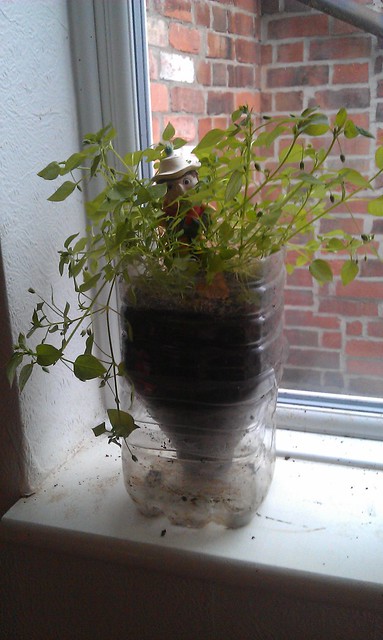
Lush and green, eh? Little flowers, trailing stems, the very picture of healthy plant life!
But wait: I've not watered that pot since Xmas. I know its a self-watering pot, but that just means that it can last a week or two when filled up, not four months. The compost in it is old and exhausted and bone dry! And yet little Miss Chickweed seems to be doing fine thank you very much. Amazing hardiness. I can only assume its nipping over the hallway to the downstairs loo in the middle of the night and having a quick drink in there.
Now I know its been wet and cold and dark since it forever (or at least feels that way) but no doubt later in the year we might well be complaining about the heat and drought (well, we can wish at least). We'll be looking at our wilting veg plots and empty rainwater butts, wondering what edible plant can cope with such drought. With heat. With cold. With full sun. With overcast darkness. With, er, more or less anything that you can throw at it.
I give you chickweed: the future of vegetable gardening in the Climate Change world.
Wednesday, 20 February 2013
Vegetarians and buffets
I've just been to an event at our local town hall that included a buffet lunch. There wasn't any option on the booking form to indicate "vegetarian" or "vegan", so I sort of assumed that the buffet would include a good smattering of well labelled veggie food at the very least. I was wrong: there were piles of pork pies and unlabelled pastries and sandwiches. I had to rely on the old veggie tactic of asking omnivores whether they thought that this or that might be veggie. This resulted in a few solid little cheese tartlets and a cheese and pickle sandwich. Good job I'm not a strict vegan or I'd have been completely stuffed.
Now I can sort of understand people self-catering for family parties who aren't used to veggies doing something like this. However this was being laid on by professional caterers. Surely its part of their professional skills to ensure that veggies, who after all make up a fair percentage of the UK population these days, are suitably catered for?
In fact why do folk serve non-veggie food at buffets at all? I've never found a meat eater who can't eat anything that doesn't contain flesh. Indeed most are quite happy to indulge in veggie foods and on occasion I've been to buffets where the veggie options have run out far more rapidly than the number of veggies at the event would indicate. When you think about it just providing a range of veggie, or better yet vegan, finger food would cover all bases and leave everyone happy. I've seen some absolutely fabulous vegan food served as buffets, pop-up kitchens or as street food as events. I can't believe everyone tucking into those was a committed vegan, yet they didn't seem to be raising any complaints.
So come on event organisers and professional caterers: get your acts together and make sure there's well labelled food that everyone can eat. If nothing else you'll be less likely to get a "rubbish buffet" response on the feedback form from the veggies you've invited.
Now I can sort of understand people self-catering for family parties who aren't used to veggies doing something like this. However this was being laid on by professional caterers. Surely its part of their professional skills to ensure that veggies, who after all make up a fair percentage of the UK population these days, are suitably catered for?
In fact why do folk serve non-veggie food at buffets at all? I've never found a meat eater who can't eat anything that doesn't contain flesh. Indeed most are quite happy to indulge in veggie foods and on occasion I've been to buffets where the veggie options have run out far more rapidly than the number of veggies at the event would indicate. When you think about it just providing a range of veggie, or better yet vegan, finger food would cover all bases and leave everyone happy. I've seen some absolutely fabulous vegan food served as buffets, pop-up kitchens or as street food as events. I can't believe everyone tucking into those was a committed vegan, yet they didn't seem to be raising any complaints.
So come on event organisers and professional caterers: get your acts together and make sure there's well labelled food that everyone can eat. If nothing else you'll be less likely to get a "rubbish buffet" response on the feedback form from the veggies you've invited.
Monday, 11 February 2013
Decentralised energy generation - a lesson for nuclear?
In the UK, as in many other countries, there's been rapid growth over the last five or so years in the amount of electrical power generated by small "micro-generation" installations. Some of these, such as domestic solar PV set ups, are small and cheap enough to be paid for by individuals. Other usually somewhat larger schemes (up to a couple of megawatts) are owned by community groups of one form or another. Most of these micro-generation projects have been based on renewable "alternative" power sources such as solar, wind or hydro. Millions of pounds are being invested in micro-generation systems - people see small, localised energy generation as a way of gaining some measure of control and involvement over the energy they use.
Whilst I think decentralised power is a great idea, and I'm fully behind getting as many renewables on the grid as possible, we're still going to need something with more energy density that can provide energy when the sun doth not shine, nor the wind bloweth. Grid level storage is part of the solution for this issue, as is grid interconnections between countries. Of course baseload generation has traditionally been the domain of the large scale coal, gas and to some extent nuclear power stations.
Now coal is a no-no for future power stations - "clean coal" seems to be a pipedream with carbon capture and storage still very much in the experimental stage and the economics looking decidedly shaky. That's without considering the "carbon cost" of getting the coal out of the ground and thousands of tons of it shipped around the planet between the mines and the power stations. Of course the UK doesn't produce much coal any more, so those "coal miles" are now seriously long journeys across the world.
George Osbourne and chums seem intent on making a second "dash for gas", either by getting the UK hooked on volatile foreign imports or kickstarting an on shore gas boom based on hydraulic fracking. Gas has a far lower carbon footprint than coal which is good, but, as the Americans seem to be rapidly discovering, fracking can be very environmentally damaging and short well productivity lifespans can result in the investment regime look more like a Ponzi scheme. We're probably going to have gas in the UK Grid mix for many decades to come, but its probably worth seeing if we can minimise it to handling rapid on/off load following applications.
Nuclear was seen by many, including surprisingly quite a few influential environmental champions, as the great white hope for large scale, low carbon energy. UK governments of several hues have pinned their hopes on it as well, but as we've seen over the last few years the plans have been somewhat derailed with many reactor vendors pulling out of schemes. Only EDF still seem to be in the race, and they'll probably only stay the course if they get underwriting guarantees from the Government and/or some buy in from the Chinese.
Part of the reason why nuclear has stumbled is the vast costs attached to the current Generation III+ designs. Part of this is a result of the regulatory and insurance landscapes surrounding nuclear power, but part of it is that these nuclear power stations will be huge, centralised power generators, each delivering somewhere between a few hundred megawatts and a gigawatt into the National Grid. Getting this sort of investment is tricky, especially in a recessionary period.
Its also a liability for the Grid. The anti-wind crowd constantly moan about what might happen to the Grid if the wind doesn't blow and the turbines suddenly stop, but the turbines are geographically spread around the UK and weather forecasting can predicted wind speeds in different areas fairly accurately out to a day or so. If a turbine fails unexpectedly the Grid might lose a couple of megawatts - a relatively easy loss to deal with. On the other hand if a gigawatt centralised nuclear station suddenly goes offline, the Grid management have their work cut out. Decentralised generation can add resilience to the Grid.
Now I reckon there's another way forward for nuclear power: instead of looking at huge, monolithic GenIII+ designs that still need billions of pounds spent for "development" and construction, we should be turning to some of the innovative, smaller GenIV designs. There's plenty of these designs floating around, and not all of them are just in the heads of the Internet's nuke geeks. Indeed a number seem to have the backing of large companies (such as Toshiba's 4S) or Government's (for example China's development of thorium reactors).
Lets imagine for a moment that one of these GenIV designs gets produced in a package that generates a few tens of megawatts and can be mass produced (maybe not in huge numbers, but with a production line at least capable of making a few hundred reactors). This sort of power output puts it in between the community owned renewables and the large scale utility power stations. If the vendors can get the price point down to a £20-50million per reactor then that puts them in the range of a large community energy project (Westmill solar PV farm for example managed to raise several million pounds in a community share issue in 2012 - I know because I've got some of those shares!). It certainly makes the attractive for commercial generators as well - one fracking company recently raised over £20million in a share listing just on the hint that there may be some potential future profits in fracked gas.
Sealed reactors limit proliferation and radioactive contamination vectors, and many of the GenIV designs are designed from the ground up as inherently walk away safe. Designs that burn up an appreciable fraction of their fuel load also limit nuclear waste issues (and the waste we've already got could be viewed as fuel in some design options, but that's another topic).
Some folk are opposed to nuclear reactors of any design, so this idea isn't likely to be popular with them. However having the option of a community sized reactor with a 5-10 year long lifespan between refuelling would give community energy schemes another avenue. If nothing else you could then offer the anti-wind community the option of the neighbourhood underground nuke station...
Whilst I think decentralised power is a great idea, and I'm fully behind getting as many renewables on the grid as possible, we're still going to need something with more energy density that can provide energy when the sun doth not shine, nor the wind bloweth. Grid level storage is part of the solution for this issue, as is grid interconnections between countries. Of course baseload generation has traditionally been the domain of the large scale coal, gas and to some extent nuclear power stations.
Now coal is a no-no for future power stations - "clean coal" seems to be a pipedream with carbon capture and storage still very much in the experimental stage and the economics looking decidedly shaky. That's without considering the "carbon cost" of getting the coal out of the ground and thousands of tons of it shipped around the planet between the mines and the power stations. Of course the UK doesn't produce much coal any more, so those "coal miles" are now seriously long journeys across the world.
George Osbourne and chums seem intent on making a second "dash for gas", either by getting the UK hooked on volatile foreign imports or kickstarting an on shore gas boom based on hydraulic fracking. Gas has a far lower carbon footprint than coal which is good, but, as the Americans seem to be rapidly discovering, fracking can be very environmentally damaging and short well productivity lifespans can result in the investment regime look more like a Ponzi scheme. We're probably going to have gas in the UK Grid mix for many decades to come, but its probably worth seeing if we can minimise it to handling rapid on/off load following applications.
Nuclear was seen by many, including surprisingly quite a few influential environmental champions, as the great white hope for large scale, low carbon energy. UK governments of several hues have pinned their hopes on it as well, but as we've seen over the last few years the plans have been somewhat derailed with many reactor vendors pulling out of schemes. Only EDF still seem to be in the race, and they'll probably only stay the course if they get underwriting guarantees from the Government and/or some buy in from the Chinese.
Part of the reason why nuclear has stumbled is the vast costs attached to the current Generation III+ designs. Part of this is a result of the regulatory and insurance landscapes surrounding nuclear power, but part of it is that these nuclear power stations will be huge, centralised power generators, each delivering somewhere between a few hundred megawatts and a gigawatt into the National Grid. Getting this sort of investment is tricky, especially in a recessionary period.
Its also a liability for the Grid. The anti-wind crowd constantly moan about what might happen to the Grid if the wind doesn't blow and the turbines suddenly stop, but the turbines are geographically spread around the UK and weather forecasting can predicted wind speeds in different areas fairly accurately out to a day or so. If a turbine fails unexpectedly the Grid might lose a couple of megawatts - a relatively easy loss to deal with. On the other hand if a gigawatt centralised nuclear station suddenly goes offline, the Grid management have their work cut out. Decentralised generation can add resilience to the Grid.
Now I reckon there's another way forward for nuclear power: instead of looking at huge, monolithic GenIII+ designs that still need billions of pounds spent for "development" and construction, we should be turning to some of the innovative, smaller GenIV designs. There's plenty of these designs floating around, and not all of them are just in the heads of the Internet's nuke geeks. Indeed a number seem to have the backing of large companies (such as Toshiba's 4S) or Government's (for example China's development of thorium reactors).
Lets imagine for a moment that one of these GenIV designs gets produced in a package that generates a few tens of megawatts and can be mass produced (maybe not in huge numbers, but with a production line at least capable of making a few hundred reactors). This sort of power output puts it in between the community owned renewables and the large scale utility power stations. If the vendors can get the price point down to a £20-50million per reactor then that puts them in the range of a large community energy project (Westmill solar PV farm for example managed to raise several million pounds in a community share issue in 2012 - I know because I've got some of those shares!). It certainly makes the attractive for commercial generators as well - one fracking company recently raised over £20million in a share listing just on the hint that there may be some potential future profits in fracked gas.
Sealed reactors limit proliferation and radioactive contamination vectors, and many of the GenIV designs are designed from the ground up as inherently walk away safe. Designs that burn up an appreciable fraction of their fuel load also limit nuclear waste issues (and the waste we've already got could be viewed as fuel in some design options, but that's another topic).
Some folk are opposed to nuclear reactors of any design, so this idea isn't likely to be popular with them. However having the option of a community sized reactor with a 5-10 year long lifespan between refuelling would give community energy schemes another avenue. If nothing else you could then offer the anti-wind community the option of the neighbourhood underground nuke station...
Friday, 25 January 2013
Snow, ice Big Society and Transition
Last Friday it started snowing in the English Midlands. Its snowed most of Friday and into Saturday but by mid-afternoon Saturday the white stuff had stopped falling, so I nipped out with the shovel and some grit and cleared our drive, the public pavement along the front of the house, a path to the front door of the little old lady next door and our neighbour's path and drive (as he works in the theatre and was just leaving when I started snow clearing, so I assumed it would an icy death trap by the time he got home as temperatures fell).
Now I've been away from here since Sunday (when it was snowing again), so I sort of assumed that when I came back, the rest of the folk in the road would have cleared their drives and paths. A couple had but for the most part the snow had just been trampled down and turned to a sheet of ice. As I went out I saw one of the other elderly ladies who lives just down the road struggling along the compacted, icy snow with her walking stick.
When I got back, I got the shovel back out and cleared all the public path from our house up the road to her house.. four or so houses worth of path clearing. Took me about 30 minutes and she came out to say thanks. No thanks were needed - this is what being in a community should be about: everyone mucking in, doing their bit and helping each other out.
If the other able bodied folk around us had just spent 20 minutes doing the bit of path outside their houses, this would all have been cleared at the start of the week. As it was, they've driven their cars over the path in and out of their drives, seemingly oblivious to the state of the pavements.
Now some people would say, "but its the council's job to clear the paths". Well I've got news for them: the council aren't clearing the paths out here. They've got their work cut out keeping the main roads and town centres clear - they don't even regularly grit the road surface on side streets like ours. I also suspect that many of these same people will be the one's who complain about the cost of council services and the amount they pay in council tax. If they want a temporary army employed at short notice to clear side streets and pavements then they'd have to be prepared to pay for it. I'd guess that a 20 minute work out shovelling the just the bit of pavement in front of their house themselves would work out a bit cheaper.
Other people claim that if they clear the public path in front of their house then they'd be liable if someone fell or that the law doesn't let them clear public spaces. The latter is nonsense: there is no law preventing you from clearing snow and ice from public spaces. It is also very unlikely that you would face any legal liability for clearing public paths if someone fell, as long as you were careful doing it and use common sense to ensure that you do not make the pavement more dangerous than before (so for example don't pour hot water on snow to melt it - eventually it will freeze and turn into black ice). Its also worth remembering that the pedestrians using areas affected by snow and ice also have responsibility to be careful themselves - you're helping them but they also have to watch out themselves.
So what's this rant got to do with Big Society and Transition Towns? Well, Big Society was supposed to be about people in local communities stepping up and taking responsibility for parts of their locality. Doing the some of the things that the armchair experts rant about, that Government and councils can no longer afford in the recession.
Clearing ice and snow would seem to fit nicely into the Big Society ideal, and if our road (and many like it) are anything to go by, the Big Society needs a kick up the pants. Its not like icy pavements are some esoteric concept that people find difficult to grasp, or can't see how volunteering a bit of their time could help the issue. Its a simple thing that is easy to deal with and makes lives easier and safer in your community. It can even save society as a whole real money - cleared pavements make it easier for people to get to work or school, and will reduce NHS costs by reducing injuries from slipping over.
Transition Towns are part of the Big Society (whether they like it or not!) and are working to build community spirit and improve local resilience. A simple task like clearing pavement ice isn't as "sexy" as planning out a community garden or getting some solar panels installed, yet it seems to be a good metric of how community minded a locality is. If a community can't do something that obvious voluntarily without anyone standing over them, then they aren't likely to step up for the more onerous tasks that we'll need do work on together in a future of ernergy constraints and climate change. Think of it as a social barometer: community cleared paths demonstrate a social responsibility that we'll increasingly need in the 21st century.
So out of the comfy armchairs folks and get those paths cleared!
Now I've been away from here since Sunday (when it was snowing again), so I sort of assumed that when I came back, the rest of the folk in the road would have cleared their drives and paths. A couple had but for the most part the snow had just been trampled down and turned to a sheet of ice. As I went out I saw one of the other elderly ladies who lives just down the road struggling along the compacted, icy snow with her walking stick.
When I got back, I got the shovel back out and cleared all the public path from our house up the road to her house.. four or so houses worth of path clearing. Took me about 30 minutes and she came out to say thanks. No thanks were needed - this is what being in a community should be about: everyone mucking in, doing their bit and helping each other out.
If the other able bodied folk around us had just spent 20 minutes doing the bit of path outside their houses, this would all have been cleared at the start of the week. As it was, they've driven their cars over the path in and out of their drives, seemingly oblivious to the state of the pavements.
Now some people would say, "but its the council's job to clear the paths". Well I've got news for them: the council aren't clearing the paths out here. They've got their work cut out keeping the main roads and town centres clear - they don't even regularly grit the road surface on side streets like ours. I also suspect that many of these same people will be the one's who complain about the cost of council services and the amount they pay in council tax. If they want a temporary army employed at short notice to clear side streets and pavements then they'd have to be prepared to pay for it. I'd guess that a 20 minute work out shovelling the just the bit of pavement in front of their house themselves would work out a bit cheaper.
Other people claim that if they clear the public path in front of their house then they'd be liable if someone fell or that the law doesn't let them clear public spaces. The latter is nonsense: there is no law preventing you from clearing snow and ice from public spaces. It is also very unlikely that you would face any legal liability for clearing public paths if someone fell, as long as you were careful doing it and use common sense to ensure that you do not make the pavement more dangerous than before (so for example don't pour hot water on snow to melt it - eventually it will freeze and turn into black ice). Its also worth remembering that the pedestrians using areas affected by snow and ice also have responsibility to be careful themselves - you're helping them but they also have to watch out themselves.
So what's this rant got to do with Big Society and Transition Towns? Well, Big Society was supposed to be about people in local communities stepping up and taking responsibility for parts of their locality. Doing the some of the things that the armchair experts rant about, that Government and councils can no longer afford in the recession.
Clearing ice and snow would seem to fit nicely into the Big Society ideal, and if our road (and many like it) are anything to go by, the Big Society needs a kick up the pants. Its not like icy pavements are some esoteric concept that people find difficult to grasp, or can't see how volunteering a bit of their time could help the issue. Its a simple thing that is easy to deal with and makes lives easier and safer in your community. It can even save society as a whole real money - cleared pavements make it easier for people to get to work or school, and will reduce NHS costs by reducing injuries from slipping over.
Transition Towns are part of the Big Society (whether they like it or not!) and are working to build community spirit and improve local resilience. A simple task like clearing pavement ice isn't as "sexy" as planning out a community garden or getting some solar panels installed, yet it seems to be a good metric of how community minded a locality is. If a community can't do something that obvious voluntarily without anyone standing over them, then they aren't likely to step up for the more onerous tasks that we'll need do work on together in a future of ernergy constraints and climate change. Think of it as a social barometer: community cleared paths demonstrate a social responsibility that we'll increasingly need in the 21st century.
So out of the comfy armchairs folks and get those paths cleared!
Friday, 19 October 2012
Local food webs and competition for resources
Recently I've been two Transition Town meetings that have mentioned mapping out food resources within a local area, usually defined as within at most 30km from the centre of the town in question. The first was a passing mention at Loughborough's Food & Gardens sub-group meeting a few weeks ago when we were discussing supporting local agriculture. Then last night at the Transition Stratford AGM it was suggested that looking at a "30:30 Challenge" might be interesting - sourcing all your food from within 30km for 30 days.
Both of these got me thinking on several fronts:


Both of these got me thinking on several fronts:
- What food resources are actually grown/raised/processed within 30km?
- What are the energy costs of these crops, compared to crops produced further away?
- What foods will we have to do without if we restrict ourselves to a 30:30 style diet?
- If we all did 30:30 diets, who would we be "competing" with for food resources within the 30km radius?
The first item on that list is going to need a bit of solid research, as its not always obvious what is grown locally or how the average consumer can access it. For example just because we can see a field of wheat down the road, it doesn't mean that we can actually buy flour locally made from just the wheat - it might well be harvested and then shipped many miles away for milling, getting mixed with other wheat in the process. Local flour mills do exist, but all too often they use grains shipped in from smaller, specialist farms elsewhere!
The energy costs one is another interesting topic. Just because we can grow something locally does not necessarily mean that its carbon footprint is lower than something grown further away. The classic example is soft fruits that need lots of heating and nutrients to be grown under glass in the UK, whereas the same fruit grown in the Mediterranean can benefit from the warmer climate, which offsets the carbon cost of the delivery journey. Of course if most of your fruit and veg can come from Grow Your Own beds in your back yard, community garden or nearby allotment, you stand a good chance of having a low footprint, which will really help in a 30:30 Challenge.
"Doing without" sounds like something from wartime rationing, but we'll need to realise that there are some foods that we just can't grow in the UK. Common ones would be rice and tea in commercial quantities (although there are some small tea plantations down in the South West we will have to have a lot more climate change induced warming to get them going in the Midlands!). For an artificial 30:30 Challenge we'll just have to grin and bear it; as Peak Oil starts to really bite we might find that foods that have become staples over the last 50 years go back to being rare treats. What will go and what can we substitute for it? Will acorn "coffee" make a come back?
However its the last item on the list that really intrigued me. If a single Transition Town does something like a 30:30 Challenge now, its a great way of encouraging people to think about local food webs, growing their own and promoting such things to the wider population. But if the fossil fuel dependent food distribution system does buckle and everyone has to get down to doing this, there'll be a heck of a lot of people competing for those local food resources.
And its not just the people you share your town with: those 30km local food webs will be drawn around every population centre. If you're in a small market town surrounded by rolling fields you might think you'll be OK, until you realise that the other side of those fields are surrounded by large towns and cities with tens of thousands, hundreds of thousands or even millions of hungry mouths to feed.
Lets take Stratford-upon-Avon as an example. Here's a Google Earth map with a 30km yellow circle centred on Stratford's public library (which is pretty much in the centre of the town).

Lots of lovely green space around the area, and plenty of agricultural activity within that, so Stratford looks like its got a good chance to source lots of its food from the local area. However now lets look at the 30km local food webs around nearby towns and cities. We'll limit ourselves at this point to just the towns and cities that are at least as big as Stratford-upon-Avon in population; that's over 25,000 people roughly:

Hmm, each of those purple circles is somebody else's local food web - notice how there isn't any of Stratford's yellow circle that doesn't intersect with at least one purple circle - often more than one.
So there's going to be lots of competition for these local food resources in the 30km radius. Its also worth being in mind that those 30km circles don't show you the relative population that's going to be seeking the food. Stratford's yellow circle will have just over 25,000 townsfolk looking to acquire locally grown grains, fruit, vegetables and livestock. However the Coventry circle has over 300,000 people with in it and around half the area of their 30km local food web is coincident with about half the Stratford one - that's roughly an order of magnitude more people just from that one city alone looking to be supported by just under half the area of Stratford's local food web. And just up the road from Coventry there's Birmingham with over a million souls to support. That's just two of the 11 competitors I've generated circles for - that's ignoring the thousands living in smaller towns and villages in the area as well.
So what does this tell us? First that, whilst a 30:30 Challenge is a good bit of PR and helps people think about local food, it obviously isn't a mechanism for preparing for a post Peak Oil world where we will be more heavily dependent on local resources. Who is planning for these sort of issues? Central Government? Local councils? Community groups? Transition Towns can play a part in that but we will a'll really need to step up our game. If its a slow decline this can be done, but what happens if the oil crisis hits more rapidly? Could well be very unpleasant.
Secondly, I think it indicates that a fixed 30km radius is a fossil fuel world's view of "local". In a future world where we'll need to be more frugal with our energy use and thus where that is heavy competition for the agricultural resources found between settlements, we'll have to potentially look at a radius dependent on population density. The carrying capacity of the land will depend on what is grown and how, but densely populated urban areas will need to access a bigger "hinterland" than smaller, less heavily populated rural towns. Thus whilst a large city might be looking 30, 40 or 50km away for food resources to feed its citizens, smaller towns and villages may well have to focus on a far more localised food web, as the resources further out will already be being claimed by the large towns and cities. 10km? Maybe less than 5km?
Thirdly, we need to remember that we are living in a post-industrial country with over 60 million people, not a mostly agrarian medieval society with a few million stomachs walking about. Industrialised agriculture and imports keeps us fed at the moment and those rely on fossil fuels. Maybe we need to move beyond just thinking about locally grown produce, artisan bakers and community gardens but also be actively looking at low energy ways of mass producing food and providing low carbon bulk shipments from where there is plenty of unpopulated land.
Tricky big problems. And really, hiding the shadows we come back to the unpopular question that we all so often try to avoid: do we have too many people for a post Peak Oil world? If we do, how can we "solve" that problem before nature and simple maths starts to solve it for us?
Sunday, 23 September 2012
Small scale wheat growing big effects
This year we've grown wheat on the allotment. Its part of the Garden Organic member's experimental trials programme, but its not something we've done before. In fact we've only ever grown one grain before - quiona - which grew OK but was a pain to harvest, thresh and winnow, especially as it looked pretty similar to some of the related weeds growing on the plot. Quiona is something that we only use very, very occasionally, so after the hassle it didn't seem worth bothering with again. Wheat on the other hand is a major part of our day to day diet, so growing a bit ourselves sounded jolly interesting.
Our trial plot is pretty tiny - about 1m wide by 2m long. According to the GO instructions this should get us enough wheat for two loaves of bread. What GO are interested in is how well the wheat grew and how we process and use it - they want to know if domestic scale grain growing is something that more gardeners might be interested in.
Our patch grew OK despite the manky summer we've had this year. It needed the odd weeding but didn't need much else - certainly no watering with the amount of rain we've had! We ended up with a nice sheaf of golden wheat sitting in the corner of my workshop to dry out a couple of weeks ago.
Now I've been slightly incapacitated recently (a long and rather unpleasant story I won't go into here) so it came to pass that yesterday I was on enforced light duties (or "rest" as my other half and the doctors had insisted). It was nice a sunny so I managed to persuade She Who Must Be Obeyed that I wouldn't explode or fall apart if allowed to sit in the sun down in the door way of my workshop and slowly thresh the wheat by hand.
What I ended up doing was removing the ears by hand a stalk or two at a time: not at all the process I'd originally intended (I was planning on putting them on a sheet and then jumping up and down to release the grains and chaff, but I doubt m'lady would have considered that "rest" and neither would my body probably). Massively time consuming, and indeed I've got a third still to do, but it was rather pleasant sitting in the warm late summer sun dealing with our harvest, listening to the wireless (a workshop has to come with a hand-me-down wireless!) and time to think.
Fiddling with the ears I began to realize the amount of effort that goes into the flour and breads that we all take for granted in the modern world. Its something I "knew" already, but this was making it real. Even though I bake my own bread, I buy in the flour, yeast, salt and sugar and usually leave the actual process to the bread machine sitting on the corner of my kitchen counter. Yet here I was getting close and personal with part of the process of getting that flour from something we scattered on the ground some months before. Obviously farm scale wheat growers and millers don't have folk hand shacking the ears, but just think of the energy use that is going into the process instead: the fuel for the combine harvesters, the transport to the mill, the power operating the milling machines and then the storage and transport to the end user. All hidden away from most people by a brown loaf in a plastic bag on a supermarket shelf.
Now whilst I'm only going to get a loaf or two out of our little two square metre patch of wheat, I'm beginning to feel that there's a greater value in growing such a small amount. It provides an education and a reconnection, another part of the food web laid bare. It might not be the crop to grow on your plot if you're after maximum production, but it could well be a great use of a little space in school and community gardens where folk could once again experience the full "pot to plate" experience of growing, processing and cooking. Its a talking point and the start of discussions and ideas.
We should be thankful for our daily bread, and doing this experiment has reawakened that for me. And if the experiment does nothing else, that's a good result for me.
Our trial plot is pretty tiny - about 1m wide by 2m long. According to the GO instructions this should get us enough wheat for two loaves of bread. What GO are interested in is how well the wheat grew and how we process and use it - they want to know if domestic scale grain growing is something that more gardeners might be interested in.
Our patch grew OK despite the manky summer we've had this year. It needed the odd weeding but didn't need much else - certainly no watering with the amount of rain we've had! We ended up with a nice sheaf of golden wheat sitting in the corner of my workshop to dry out a couple of weeks ago.
Now I've been slightly incapacitated recently (a long and rather unpleasant story I won't go into here) so it came to pass that yesterday I was on enforced light duties (or "rest" as my other half and the doctors had insisted). It was nice a sunny so I managed to persuade She Who Must Be Obeyed that I wouldn't explode or fall apart if allowed to sit in the sun down in the door way of my workshop and slowly thresh the wheat by hand.
What I ended up doing was removing the ears by hand a stalk or two at a time: not at all the process I'd originally intended (I was planning on putting them on a sheet and then jumping up and down to release the grains and chaff, but I doubt m'lady would have considered that "rest" and neither would my body probably). Massively time consuming, and indeed I've got a third still to do, but it was rather pleasant sitting in the warm late summer sun dealing with our harvest, listening to the wireless (a workshop has to come with a hand-me-down wireless!) and time to think.
Fiddling with the ears I began to realize the amount of effort that goes into the flour and breads that we all take for granted in the modern world. Its something I "knew" already, but this was making it real. Even though I bake my own bread, I buy in the flour, yeast, salt and sugar and usually leave the actual process to the bread machine sitting on the corner of my kitchen counter. Yet here I was getting close and personal with part of the process of getting that flour from something we scattered on the ground some months before. Obviously farm scale wheat growers and millers don't have folk hand shacking the ears, but just think of the energy use that is going into the process instead: the fuel for the combine harvesters, the transport to the mill, the power operating the milling machines and then the storage and transport to the end user. All hidden away from most people by a brown loaf in a plastic bag on a supermarket shelf.
Now whilst I'm only going to get a loaf or two out of our little two square metre patch of wheat, I'm beginning to feel that there's a greater value in growing such a small amount. It provides an education and a reconnection, another part of the food web laid bare. It might not be the crop to grow on your plot if you're after maximum production, but it could well be a great use of a little space in school and community gardens where folk could once again experience the full "pot to plate" experience of growing, processing and cooking. Its a talking point and the start of discussions and ideas.
We should be thankful for our daily bread, and doing this experiment has reawakened that for me. And if the experiment does nothing else, that's a good result for me.
Saturday, 1 September 2012
LibraryThing, Android and a cool ZXing barcode feature
I use LibraryThing to manage my personal book collection. Its a handy way of tracking what books I've bought and what I've leant out to folk. What I really want though is to be able to check LibraryThing quickly and easily whilst I'm schmoozing the shelves in the local second hand book shops, mostly so that I don't accidentally buy another copy of a book I've already got (again!).
Luckily I've usually got an Android phone sitting in my pocket, which has a camera (two actually) and the handy ZXing barcode scanning app installed. I've played with the barcode scanner using Perl under SL4A and was able to capture ISBN barcodes and check them against a list I held on the phone. However the script was rather basic and getting my collection data out of LibraryThing would be a bit of a pain, as the SL4A version of Perl has neither a copy of the LWP web access module, nor a (working) version of CPAN with which to install it. It does have IO::Socket so I started along that track to build a pure Perl client from the ground up - a bit long winded but doable. Writing a decent UI in Perl using the Android API exposed by SL4A would be a bit of a pain though.
However last night I got distracted rereading the online version of a book I'd read in paper form when I first got my Android phone: the excellent Building Android Apps with HTML, CSS, and JavaScript by Jonathan Stark. This describes how you can optimise web pages to the Android platform using HTML 5 and JavaScript and, more importantly, then use those pages as the basis for a native app. So this morning I sat down and had a bit of a tinker.
Its surprisingly easy to knock together something that looks fairly respectable quite quickly, especially as you can crib from Jonathan's existing code frame work. Within an hour or so I'd got a simple web page using JQTouch running that allowed me to fetch my LibraryThing collection (using their JSON Books API), list the works on that I've got in my collection (including pulling cover art from LibraryThing where available) and check if a book is in my list by manually entering its ISBN. Jonathan explained in the book how you can use localStorage and the HTML 5 database features to provide stand alone storage on the phone, and the JQTouch provides exciting UI animations, etc, whilst allowing the use of the JQuery compatible(ish) Zepos library to handle the AJAX/JSONP stuff.
So that's the heavy lifting done for talking to LibraryThing: now how do I get barcode scanning to work? Turns out after some researching there's several options (probably even more than this if I really put my mind to it - for example the hardcore Java coders would probably add hacking up their own version of ZXing to the list):
Luckily I've usually got an Android phone sitting in my pocket, which has a camera (two actually) and the handy ZXing barcode scanning app installed. I've played with the barcode scanner using Perl under SL4A and was able to capture ISBN barcodes and check them against a list I held on the phone. However the script was rather basic and getting my collection data out of LibraryThing would be a bit of a pain, as the SL4A version of Perl has neither a copy of the LWP web access module, nor a (working) version of CPAN with which to install it. It does have IO::Socket so I started along that track to build a pure Perl client from the ground up - a bit long winded but doable. Writing a decent UI in Perl using the Android API exposed by SL4A would be a bit of a pain though.
However last night I got distracted rereading the online version of a book I'd read in paper form when I first got my Android phone: the excellent Building Android Apps with HTML, CSS, and JavaScript by Jonathan Stark. This describes how you can optimise web pages to the Android platform using HTML 5 and JavaScript and, more importantly, then use those pages as the basis for a native app. So this morning I sat down and had a bit of a tinker.
Its surprisingly easy to knock together something that looks fairly respectable quite quickly, especially as you can crib from Jonathan's existing code frame work. Within an hour or so I'd got a simple web page using JQTouch running that allowed me to fetch my LibraryThing collection (using their JSON Books API), list the works on that I've got in my collection (including pulling cover art from LibraryThing where available) and check if a book is in my list by manually entering its ISBN. Jonathan explained in the book how you can use localStorage and the HTML 5 database features to provide stand alone storage on the phone, and the JQTouch provides exciting UI animations, etc, whilst allowing the use of the JQuery compatible(ish) Zepos library to handle the AJAX/JSONP stuff.
So that's the heavy lifting done for talking to LibraryThing: now how do I get barcode scanning to work? Turns out after some researching there's several options (probably even more than this if I really put my mind to it - for example the hardcore Java coders would probably add hacking up their own version of ZXing to the list):
- I could turn the HTML/JavaScript/CSS into a native Android app using PhoneGap. This has several advantages: you can access the barcode scanner directly using a PhoneGap extension, you won't need a network connection whilst scanning if you've already downloaded a local copy of your LibraryThing collections and you'll end up with an .apk archive that folk can easily download and can be put on the Android marketplace (or Google Play or whatever its called this week).
- I could go back to the SL4A Perl script and use the HTML/Javascript/CSS as a front end (or replicate it using the SL4A UI calls) and then call the barcode scanner Intent from there. Bit messy and it wouldn't be terribly easy to give to other people.
- Stick with the web delivered application and make use of a cool feature of ZXing that I've only just come across today: ZXing intercepts links in web pages that have a target of zxing.appspot.com/scan, and either fires up the barcode scanner or asks the user if they'd like to install it to use. Assuming the barcode scanner is installed and working, you can then scan a barcode which can then gets sent to a URL of your choice. This does mean that there's a need for a server side application to collect the scanned data, but I'm wondering if I can work round that using some sort of local URL to the phone. More playing needed really - at the moment I've just tested the system by pointing ZXing at the LibraryThing works URL once it has captured a barcode and that seems to work fine. Apparently there's a similar URL that you can using on iOS devices that have ZXing installed (but I've not got one of those so can't try it myself).
- Forget the whole thing once I'd realised that the standard ZXing barcode scanner app has the ability to have a custom search URL defined which can be set to "http://www.librarything.com/isbn/%s". Then clicking on the custom search button once a barcode has been recognised will whisk you off to LibraryThing, which (at least for me) automatically logs me in thanks to stored cookies. This works fine, though the downside is that you need a live network connection obviously.
In case anyone is interested I've popped the "ALT" web application online if you fancy playing with it. Even if I don't go down the route of turning that into a native app using PhoneGap, its been interesting to see how far CSS hackery lets you tart up web pages for mobile devices - useful skillz to tuck away for the future no doubt.
Saturday, 25 August 2012
Garden Organic trials progress
A while back I posted about our tomato plants that form part of Garden Organic's blight resistant tomato plant trials. We'll since then we've had some potential blight appearing on the leaves of some of the A, C and D varieties, and as of this week a few ripe tomatoes from A and C, both of which seemed quite tasty (both on their own and halved, then popped on top of homous on a water cracker. Looked like a sort of flat savoury cup cake!). Lots more green tomatoes, especially on variety A.
Variety B has much greener, healthier looking foliage than the others, but has only just flowered. Its obviously a later type - either that or its poor germination and the rotten summer haven't helped it. I've a sneaking feeling that B is the odd one out... either that's the very blight resistant variety or else its some sort of control variety.
We're also taking part in the Garden Organic small scale wheat experiment. This means growing a two square metre bed of organic wheat supplied by GO, and then recording how it was sown, grown, harvested, threshed, winnowed and used. We've gone throw sowing, growing and now just done harvesting. We got a good size wheat sheaf out of the bed - a bit green tinged in places but I've read recently that's OK, and lots of the farmers round here have been harvesting their crops so I guess its a good time to get it in. Just as well, as its rained on and off for the past two days since we cut it. Its currently sitting in my workshop out of the rain to finish drying off.
Next we'll have to thresh the wheat to release the dried grains from the stalks. I've a cunning plan for this: I'm going to hold bunches of stalks upside down in a 25 litre brewing mash bucket and whack the heads against the sides! This will hopefully knock the grains out and capture them into the bucket. Winnowing is going to be more interesting: I tried doing it a few years ago when harvesting some quiona and wasn't terribly adept at the operation. I ended up picking the chaff out by hand after coating the attic floor in seed/chaff mixture!
Assuming I'm less fumble fingered and we end up with a small measuring jug of grain, the next thing to do will be to use the grain in cooking. I'd planned on trying to use it to make a loaf of bread in our Panasonic bread maker, but to do that we'll need to work out how to grind the grains into flour. I did some web searching for domestic grain mills and, whilst they exist, they're pretty dear, especially for a one off experiment. I did find a grinding mill in Lakeland for just under twenty quid but it didn't mention "grains" amongst the things it would mince or grind (meat, vegetables, nuts, beans). Might still get one though as it might be handy for make veg/nut/bean spreads and it can also turn out some pasta as well. I'll also keep a weather eye on the local second hand shops - you never know if an old hand mill might turn up. I'll add it to my list of 2nd hand items I look for when mooching round such shops - still not spotted any fruit presses or large maslin pans yet!
Variety B has much greener, healthier looking foliage than the others, but has only just flowered. Its obviously a later type - either that or its poor germination and the rotten summer haven't helped it. I've a sneaking feeling that B is the odd one out... either that's the very blight resistant variety or else its some sort of control variety.
We're also taking part in the Garden Organic small scale wheat experiment. This means growing a two square metre bed of organic wheat supplied by GO, and then recording how it was sown, grown, harvested, threshed, winnowed and used. We've gone throw sowing, growing and now just done harvesting. We got a good size wheat sheaf out of the bed - a bit green tinged in places but I've read recently that's OK, and lots of the farmers round here have been harvesting their crops so I guess its a good time to get it in. Just as well, as its rained on and off for the past two days since we cut it. Its currently sitting in my workshop out of the rain to finish drying off.
Next we'll have to thresh the wheat to release the dried grains from the stalks. I've a cunning plan for this: I'm going to hold bunches of stalks upside down in a 25 litre brewing mash bucket and whack the heads against the sides! This will hopefully knock the grains out and capture them into the bucket. Winnowing is going to be more interesting: I tried doing it a few years ago when harvesting some quiona and wasn't terribly adept at the operation. I ended up picking the chaff out by hand after coating the attic floor in seed/chaff mixture!
Assuming I'm less fumble fingered and we end up with a small measuring jug of grain, the next thing to do will be to use the grain in cooking. I'd planned on trying to use it to make a loaf of bread in our Panasonic bread maker, but to do that we'll need to work out how to grind the grains into flour. I did some web searching for domestic grain mills and, whilst they exist, they're pretty dear, especially for a one off experiment. I did find a grinding mill in Lakeland for just under twenty quid but it didn't mention "grains" amongst the things it would mince or grind (meat, vegetables, nuts, beans). Might still get one though as it might be handy for make veg/nut/bean spreads and it can also turn out some pasta as well. I'll also keep a weather eye on the local second hand shops - you never know if an old hand mill might turn up. I'll add it to my list of 2nd hand items I look for when mooching round such shops - still not spotted any fruit presses or large maslin pans yet!
Friday, 22 June 2012
Getting bikes on trains
I'm a non-driver, so I'm often found taking trains around the country. I'm also not a cyclist, but that's mostly because my girlfriend has banned me from "pedalling the pedals" for the safety of both myself and those around me (I admit I can get rather easily distracted or absorbed in thought - more than once I've done the hour long walk to work and suddenly realised as I opened the building door that I couldn't remember actually crossing any of the roads to get there!). However I think cycling is a great way of commuting for folk how are a bit more mentally with it. If you live within 5 miles of work, cycling directly there should be something you should consider for your own health, to help reduce road congestion and help cut down on pollution.
Couple a bike with a commuter train and you've potentially got a great commuter transport option: cycle to the station, catch the train with your bike and then hop back on the bicycle for a quick cycle to your place of work/education. I know several people who do just that, coming to Loughborough from Nottingham, Derby or Leicester, and I've seen people at Loughborough station who are obviously doing the opposite run.
Whilst I'm a non-cyclist my train usage means I've seen plenty of bikes, both "folders" and normal non-folding examples, popped into carriage vestibules or wedged into one of the little cycle spaces that are provided on some services. I'm also old enough that I can remember "proper trains" with large guards vans that could take large numbers of bikes (and push chairs and folks in wheelchairs and large luggage) that unfortunately modern train designs have swept away. Thus I'm very aware that there's not actually that much space available for bikes, although what space is available seems to be offered for free to riders by most train companies.
Today there's a bus drivers strike going on in London, and I noticed that Chiltern Railways (one of the best UK train operating companies in my experience) where encouraging folk to walk or cycle where possible when they got to the capital. My first thought was "good on yer Chiltern Railways for promoting walking and cycling". Then I thought, "hmm, I wonder how many bikes they can get on each train to allow this?" A bit of Googling threw up the AtoB website's cycles and trains page, which seemed to unfortunately indicate that cycles aren't allowed on some of their peak period trains! You'd think they'd at least allow
However the thing that really struck me was the wide range of rules and regulations on cycle carriage from all the train operating companies. Even companies that are using more or less the same rolling stock have completely different rules and attitudes to cycle carriage on their trains. The fact that lots of them seem to restrict (at least on paper) the carriage of cycles, even folding cycles in some cases, on peak hour trains rather stuffs up the cycle-train-cycle commuting option for many people. I guess at least if you are a regular commuter you can get used to rules implemented by the particular train operating company(s) that you regularly use. However this mish-mash of contradictory regulations doesn't encourage the occasional use of cycles for the first/last mile of other, less regular train journeys such as people going to meetings, visiting granny, nipping to a city for shopping, etc, especially as those sorts of journeys are more likely to require changes between different train operating companies.
In the past the Government via the Office of the Rail Regulator has got the train operating companies together via their ATOC association to force them to review and try to simplify ticketing rules (with admittedly limited success). I wonder if they, or anyone else with some clout, are capable of getting the cycle carriage rules standardised across the network (or at least across identical rolling stock)? I guess another solution would be a national "Boris Bike" scheme were you could pick up a loaner bike for a few hours at every railway station but that's another post for another day!
Sunday, 3 June 2012
Garden Organic Members' Experiments Progress
A while back m'lady and I decided to take part in a couple of the Garden Organic members' experiments. We opted for the garden scale wheat trial and the blight resistant tomato tests. After a tense couple of weeks of waiting to see if we were accepted (being new boy late comers to this game) we received a pleasingly chunky envelope containing the required seeds, some background information and the data sheets we needed to complete for each trial.
We quickly got a bed at the allotment prepared for the wheat - cleared of weeds, levelled and then had the wheat seed broadcast across it. A quick raking over and that was the wheat trial under way for us - all done by the middle of April. Within a couple of weeks the first little green leaves were already showing, although the progress was a bit slow after that thanks to the rather odd Spring weather this year. Still, nothing much to be done with the wheat now until late July when, hopefully, we'll be harvesting golden ears and working out how to thresh, mill and bake with them (which is really the main reason behind the experiment - can a small patch of wheat be grown by gardeners and then turned into something useful).
Meanwhile the tomato experiment could get underway indoors, despite the toms actually being outdoor varieties. The point of this experiment is to trial four different tomato varieties and see what their resistance is to the evil blight (Phytophthora infestans for those playing along at home). Blight is something we've been cursed with before - we lost an entire main crop potato harvest three or four years ago, and then some almost ripe tomatoes the following year - so this an experiment we're obviously rather interested in. I can't tell you much about the varieties we're growing as they are only known to us as the mysterious labels A, B, C and D.
Once 10 seeds each of A, B, C and D were sown, they rested in the propagator in m'lady's lounge window sill, alongside our normal indoor toms. The weather decided to be grey, manky and cold for weeks on end, so germination was a bit slow at first. Eventually A, C and D got going (along with our normal, non-experimental toms) and between 5 and 9 little seedlings appeared in the pots. Tomato B steadfastly refused to germinate though - we thought at one point it was going to be a complete no-show. Eventually one little 'B' appeared and after waiting for some weeks (during which A, C, D were growing madly) we resigned ourselves to only having one Tom B for the trial
.
Today was "potting on and putting out" day. One each of A, B, C and D got put into 8 litre pots containing a mixture of home made compost topped off with some Vital Earth vegetable compost and a handful of slow release organic fertilizer. Due to my poor planning and thus a slight lack of veg compost we then potted up two more each of A, C and D, and all of these got popped outside on m'lady's patio to soak up the gentle Summer sun. Or as it turns out on this royal Bank Holiday weekend, soak up the gentle English rain.
We've sourced some more compost (last bag of Vital Earth veg compost at Charlecote Garden Centre, which I think demonstrates how good it is compared to the masses of some other brands still stacked on pallets there) and we'll pot up some more of A, C and D later today. These will also get squeezed in somewhere in m'lady's increasingly well filled back garden. Who wants scented roses when there's some serious garden science to be done, eh?
Then bizarrely we actually need some more of the warm English rain, as that's what spreads the blight spores. Apparently this experiment is a rerun of a similar trial made last year, when it wasn't wet enough during the tomato growing season and thus few people had blight hit their trial toms. I'm in two minds really. I'd like to get some useful results for the Garden Organic folk from this experiment which may help long term in providing blight resistant tomato strains. On the other hand I'd really like to see what toms A, B, C and D actually taste like. After all there'd be little point in growing blight-proof toms that taste like supermarket commercial varieties!
We quickly got a bed at the allotment prepared for the wheat - cleared of weeds, levelled and then had the wheat seed broadcast across it. A quick raking over and that was the wheat trial under way for us - all done by the middle of April. Within a couple of weeks the first little green leaves were already showing, although the progress was a bit slow after that thanks to the rather odd Spring weather this year. Still, nothing much to be done with the wheat now until late July when, hopefully, we'll be harvesting golden ears and working out how to thresh, mill and bake with them (which is really the main reason behind the experiment - can a small patch of wheat be grown by gardeners and then turned into something useful).
Meanwhile the tomato experiment could get underway indoors, despite the toms actually being outdoor varieties. The point of this experiment is to trial four different tomato varieties and see what their resistance is to the evil blight (Phytophthora infestans for those playing along at home). Blight is something we've been cursed with before - we lost an entire main crop potato harvest three or four years ago, and then some almost ripe tomatoes the following year - so this an experiment we're obviously rather interested in. I can't tell you much about the varieties we're growing as they are only known to us as the mysterious labels A, B, C and D.
Once 10 seeds each of A, B, C and D were sown, they rested in the propagator in m'lady's lounge window sill, alongside our normal indoor toms. The weather decided to be grey, manky and cold for weeks on end, so germination was a bit slow at first. Eventually A, C and D got going (along with our normal, non-experimental toms) and between 5 and 9 little seedlings appeared in the pots. Tomato B steadfastly refused to germinate though - we thought at one point it was going to be a complete no-show. Eventually one little 'B' appeared and after waiting for some weeks (during which A, C, D were growing madly) we resigned ourselves to only having one Tom B for the trial
.
 |
| The tomato experimental subjects |
We've sourced some more compost (last bag of Vital Earth veg compost at Charlecote Garden Centre, which I think demonstrates how good it is compared to the masses of some other brands still stacked on pallets there) and we'll pot up some more of A, C and D later today. These will also get squeezed in somewhere in m'lady's increasingly well filled back garden. Who wants scented roses when there's some serious garden science to be done, eh?
Then bizarrely we actually need some more of the warm English rain, as that's what spreads the blight spores. Apparently this experiment is a rerun of a similar trial made last year, when it wasn't wet enough during the tomato growing season and thus few people had blight hit their trial toms. I'm in two minds really. I'd like to get some useful results for the Garden Organic folk from this experiment which may help long term in providing blight resistant tomato strains. On the other hand I'd really like to see what toms A, B, C and D actually taste like. After all there'd be little point in growing blight-proof toms that taste like supermarket commercial varieties!
Sunday, 6 May 2012
Will the Night Mail Return?
Back when I was a nipper, British Rail used to run a fair few trains during the wee hours of the night. The night mails and the newspaper trains. Back in the days of yore some of these had passenger accommodation tacked on so that you could, if you wished, get an inter-city service well after the pubs had shut (not that that was a major factor for a nipper, especially as I'm tea-total).
These train services have long since disappeared. The newspaper trains were the first to go as production of newspapers was decentralised and so large volumes of paper didn't need to be shifted from London to the provinces. The mail trains became dedicated services with no passenger stock added, and then the mail trains themselves passed into history, replaced by yet more lorries trundling along the motorways and trunk roads of Britain. We've still got a rump of the old sleeper services, which I used a couple of years ago to get up to Scotland for a holiday with my girlfriend, but they're more the exception than the rule now, and may soon be no more when ScotRail's franchise is renewed in 2014.
So you're probably asking now why Jim'll is wittering on about the overnight trains of yesteryear? Well, bear with me!
I've been considering transport energy use (for which there's another one of my long, dull, full-of-numbers blog posts brewing!) and I've just been watching Robert Llewelyn's Fully Charged episode on the National Grid control centre. With oil prices constantly on the rise, looking at alternative transport options such as electric vehicles is a sensible thing to be doing now.
During Robert's show, the National Grid control chap said that power generation would be more efficient if the overnight "bath tub" lull in electricity demand could be "filled up". In other words it would be more efficient to generate a bit less energy during the day, if we could use more at night to offset the daytime reduction. In the Fully Charged show they were talking about the charging of electric vehicles over night, which the National Grid controller said might eventually consume about a gigawatt overnight, which would help fill the bath tub up slightly, but when the national peak energy use is between 40-60GW, there's quite a bit more capacity to use up.
So we obviously need to think of more things that could be run overnight using the cheaper off peak electricity. There's plenty of options of course - dish washers, washing machines, etc in the home, lots of industrial processes could be run 24/7, and we could use cheap overnight power for hydrogen cracking or even synthesising liquid hydro-carbon fuels from air and water.
Now what about those overnight trains? A single electric express train uses several megawatts to get up to speed and there are plans afoot to get more the UK rail network electrified (for example Loughborough's MP recently debated the electrification of the Midland Mainline in Parliament). The rail network is also increasingly popular and thus increasingly over crowded. Even during the day and weekend intercity services are often standing room only - its not just the peak hours services. There are more expensive infrastructure projects intended to help with that by laying extra tracks or building new lines - High Speed 2 being an example - but we need to make better use of the infrastructure we've already got as well.
So what if we tried to move some people around the country using cheap overnight power using electric rail traction? If the tickets prices were suitably attractive there's probably quite a few people who would want to take advantage of such trains. The current sleeper services definitely aren't cheap (though often cheaper than the train plus a hotel at the far end, plus quite convenient), but there's always folk on the bargain basement cross country road coaches, so there's probably a market there. The ticket prices would need to cover the electricity costs (which are cheaper overnight remember), the staff to run the service and the service's share of track and station maintenance costs. The Train Operating Companies can already sell some tickets on less popular services at knock down prices, so we might well be looking at similar prices for a "Witching Hour" overnight ticket.
If we want a modal shift in transportation in a world where oil is getting increasingly expensive maybe the rail companies should get together with the National Grid and see if there's a way they can help move people around more efficiently. Efficient use of rail infrastructure coupled with efficient use of power generation and distribution infrastructure seems to be a good idea to me, especially if it means being able to get back from a gig in London in the wee hours!
These train services have long since disappeared. The newspaper trains were the first to go as production of newspapers was decentralised and so large volumes of paper didn't need to be shifted from London to the provinces. The mail trains became dedicated services with no passenger stock added, and then the mail trains themselves passed into history, replaced by yet more lorries trundling along the motorways and trunk roads of Britain. We've still got a rump of the old sleeper services, which I used a couple of years ago to get up to Scotland for a holiday with my girlfriend, but they're more the exception than the rule now, and may soon be no more when ScotRail's franchise is renewed in 2014.
So you're probably asking now why Jim'll is wittering on about the overnight trains of yesteryear? Well, bear with me!
I've been considering transport energy use (for which there's another one of my long, dull, full-of-numbers blog posts brewing!) and I've just been watching Robert Llewelyn's Fully Charged episode on the National Grid control centre. With oil prices constantly on the rise, looking at alternative transport options such as electric vehicles is a sensible thing to be doing now.
During Robert's show, the National Grid control chap said that power generation would be more efficient if the overnight "bath tub" lull in electricity demand could be "filled up". In other words it would be more efficient to generate a bit less energy during the day, if we could use more at night to offset the daytime reduction. In the Fully Charged show they were talking about the charging of electric vehicles over night, which the National Grid controller said might eventually consume about a gigawatt overnight, which would help fill the bath tub up slightly, but when the national peak energy use is between 40-60GW, there's quite a bit more capacity to use up.
So we obviously need to think of more things that could be run overnight using the cheaper off peak electricity. There's plenty of options of course - dish washers, washing machines, etc in the home, lots of industrial processes could be run 24/7, and we could use cheap overnight power for hydrogen cracking or even synthesising liquid hydro-carbon fuels from air and water.
Now what about those overnight trains? A single electric express train uses several megawatts to get up to speed and there are plans afoot to get more the UK rail network electrified (for example Loughborough's MP recently debated the electrification of the Midland Mainline in Parliament). The rail network is also increasingly popular and thus increasingly over crowded. Even during the day and weekend intercity services are often standing room only - its not just the peak hours services. There are more expensive infrastructure projects intended to help with that by laying extra tracks or building new lines - High Speed 2 being an example - but we need to make better use of the infrastructure we've already got as well.
So what if we tried to move some people around the country using cheap overnight power using electric rail traction? If the tickets prices were suitably attractive there's probably quite a few people who would want to take advantage of such trains. The current sleeper services definitely aren't cheap (though often cheaper than the train plus a hotel at the far end, plus quite convenient), but there's always folk on the bargain basement cross country road coaches, so there's probably a market there. The ticket prices would need to cover the electricity costs (which are cheaper overnight remember), the staff to run the service and the service's share of track and station maintenance costs. The Train Operating Companies can already sell some tickets on less popular services at knock down prices, so we might well be looking at similar prices for a "Witching Hour" overnight ticket.
If we want a modal shift in transportation in a world where oil is getting increasingly expensive maybe the rail companies should get together with the National Grid and see if there's a way they can help move people around more efficiently. Efficient use of rail infrastructure coupled with efficient use of power generation and distribution infrastructure seems to be a good idea to me, especially if it means being able to get back from a gig in London in the wee hours!
Subscribe to:
Posts (Atom)